
The Caretaker at the Center: Dennis Ortiz Has Seen It All
If you were to imagine the qualities needed to be the caretaker of a wildlife center in the high desert of Northern New Mexico, your list might include: grit, tough with boundaries, tender with animals, not easily ruffled, vigilant, and watchful. This fits Dennis Ortiz, the groundskeeper and facility caretaker of New Mexico Wildlife Center. It’s an unusual job, and he is uniquely suited to serve this role. What made him who he is and how did he wind up as the Center’s on-site guardian for more than two decades?
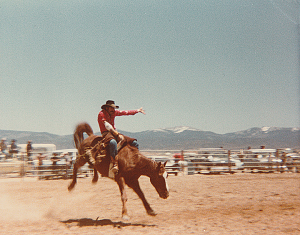
With the Sangre de Cristo mountains in the distance, Dennis competes in the rodeo
Before New Mexico Wildlife Center
“Not to brag, but I think I was bred for this, because I was a rowdy kid.”
A self-described Norteño, Dennis grew up in LaJara, Colorado under the education of the Catholic Church. He earned the nickname Dennis the Menace for his rambunctious energy, which he learned to focus on athletics and animals, following warnings from the Dominican sisters who taught him. Dennis says, “I was quite a standout athlete. I had a lot of scholarships for colleges, but I give all the credit to the sisters, because they used to tell me, ‘Dennis, you’re falling behind on your grades. You know what that means? You’re gonna be warming the bench, boy’.” He went on to attend Adams State University in Alamosa.
He also gives credit to his father and mentor, Frank Ortiz, who was a well-known sheep shearer. Dennis would tag along with him and he had a job to do. “I was a wool tyer. I had to throw the wool up and stand in a big sack, and I’d drop them in there and tromp them. I was a tromper and tyer.” Dennis eventually began breaking horses, and gained clientele through the reputation his father had throughout northern New Mexico. His involvement with horses included bareback riding in the Professional Rodeo Cowboys Association and working as a stuntman for movies. When this lifestyle became too hard on his body, he thought being a farrier might be easier, but that also proved to be physically demanding.
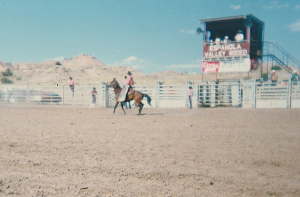
The fairgrounds and rodeo arena in the 1980’s with the neighboring La Puebla Recreation Area
Horsemanship skills are what brought him to the Center, before the Center was here. Dennis recalls, “They were going to build the Espanola Valley Rodeo and Fair. So they asked my father and I to be the groundskeepers at that time. And so we moved in a little trailer, and watched the progress. They had a big arena and gazebo, and it rocked! It got really good, very popular. We had circuses, carnivals, the county fair. They had all the kids with their lambs and the big steers. And the rodeo became fantastic! These Norteños, these northern people, they love that.”
The Little Bear Lady, Dr. Ramsay
When the fairgrounds relocated into Rio Arriba county proper, Dennis and his father Frank Ortiz stayed. “They pulled the arena out, they dropped the gazebo, and kind of left this barren. My father and I took care of it. There were no fences. So it was, like, in the Badlands. And then, we kept seeing this little pickup truck coming around, just snooping around, snooping around. And finally, I went out and I confronted the person, and it was, lo and behold, Dr. Kathleen Ramsay, the founder. She says, ‘I’m spotting a place for the Wildlife Center’.”
True to his nature of staying in the background, Dennis defers to the “little bear lady” who, after Frank Ortiz passed away, kept Dennis on and made sure he felt welcome and remained the resident guardian of the facility. Reflecting on this new development in the Española Valley, he solemnly believes Dr. Ramsay brought a “blessing to the area” through founding the Center.
Taking Care of the Grounds and Animals
A steady presence who knows everyone, or is related to everyone, who lives near the Center, Dennis and his partner Debbie reside on-site and provide watchful guard over the 20 acres with an eye on the adjacent recreational open space. “I appreciate it. I enjoy it. I do my best. I come down early, I work hard. I’ve kept up with the place. We’ve never been broken into. Nobody has shot at us,” Dennis says.
Dennis witnessed the transition of the facility from the rough-and-tumble wild west to a sanctuary for healing and education. Over the past two decades of the Center being located at this site, he got to know many Ambassador Animals. “That came about with my love for the horses, and then the horses were gone. I started seeing the wild animals they were bringing in – the Bobcats, the Red-tailed Hawks. I fell in love with their species and their beauty.” He fondly remembers some of the long-term residents that he checked on daily. “We had Sol, the Vulture. Oh, I loved him. Then we had Maxwell, the Bald Eagle, and Olivia. I never worked with them but I helped handle Maxwell one time.”
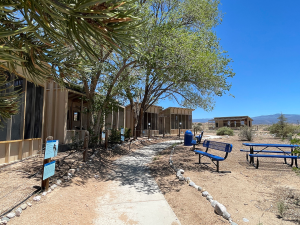
Today, the NMWC grounds house more than 30 educational Ambassador Animals
In a 2007 newsletter article, this incident was related by Mary Kanda:
One morning, Dennis noticed blood spattered on the wall where Maxwell (the great, much-loved Bald Eagle) is housed. Dennis called this to the attention of a staff member, who arrived shortly after. Together, they were able to catch the bird and work with Dr. Ramsay to treat the broken wing feather. Maxwell was saved from a potentially life-threatening injury.
Being the first to put eyes on the animals in the morning is an important job. “I’ve always just taken care of them by seeing them, making sure they’re all right.” He also stewards the Center’s native plant gardens and landscape by watering the trees, emptying trash bins, and other custodial tasks.
Over the years, there have been challenges that he has faced like a true cowboy regularly monitoring the fenceline, and recalls the days before a fence was there at all. “The biggest problem is human nature,” Dennis says. “There for a while, I felt like Matt Dillon. I’d be getting up at three in the morning. There’d be people up there partying, breaking glasses.” It’s a good thing Dennis has friends with badges.
More frequent intruders he has managed include stray dogs and masses of tumbleweeds. He says, “In Spanish, this place was called the Llano, the prairie land. I made a big, portable corral. I would go haul tumbleweeds in my truck, because there were so many. And I’d stick all the tumbleweeds in the corral. Then Dr. Ramsay would call the volunteer fire department, and they would burn them. That kept the weeds down. But then, we were concerned that the smoke was bothering the birds. So we canceled that. That was my biggest problem, tumbleweeds.”
A Shift in Perspective
Dennis serves as an unofficial educational ambassador himself, representing a different perspective of working with animals than the one he started out with in life. Dennis shares, “Everybody that I’ve talked to – that knew me a long time ago, when I was into rodeo and being crazy or wild – they told me, ‘Man, you settled down.’ I go, ‘Yeah, I take care of the Wildlife Center.’ And then I start telling them about the ambassadors and the programs. They say, ‘We’ll be out.’ and I’ve seen a lot of people coming that weren’t here before.”
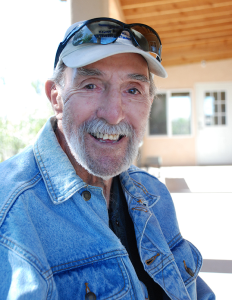
Dennis Ortiz, caretaker at New Mexico Wildlife Center, summer 2026
When Dennis talks about the Center’s legacy of educating people, and remembers his father’s legacy of being the sheep shearer, he humbly says what he hopes he’s remembered for, “That I’ve always been a nice person.”
The path he traveled to this realization wasn’t smooth. Sharing another pivotal moment in his life, Dennis says, “I served in Vietnam for three years. That helped me a lot to see humanity. After coming from these war-torn and poverty-stricken countries, and all that, I have so much appreciation for the United States of America. And I’ve kept that in the back of my heart, and in my soul, that I’m proud to be an American, and I’m gonna keep it all till I die.”
Relating that experience to the lessons he has learned during his time at the New Mexico Wildlife Center, he notices the difference that education makes. Dennis says, “I see the way that the Wildlife Center has brought people together. They learn how to respect animals. I can see what it’s done to the public.”
This is what he hopes will continue in the future. In short, Dennis summarizes his new philosophy on coexistence with wildlife. “Let them know that humans and animals gotta get along. This world, God didn’t make it just for us. He made it for all of us. And I see that with the future, I think it’s gonna get a whole lot better.”