Meet our Education Ambassador Animals! Our education staff, along with our Ambassador Animals, present wildlife conservation programs at schools, community organizations, libraries, and here at NMWC in Espanola. To help us care for the Ambassador Animal Team, visit our new Ambassador Animal Team Keystone Sponsorship page.
Birds
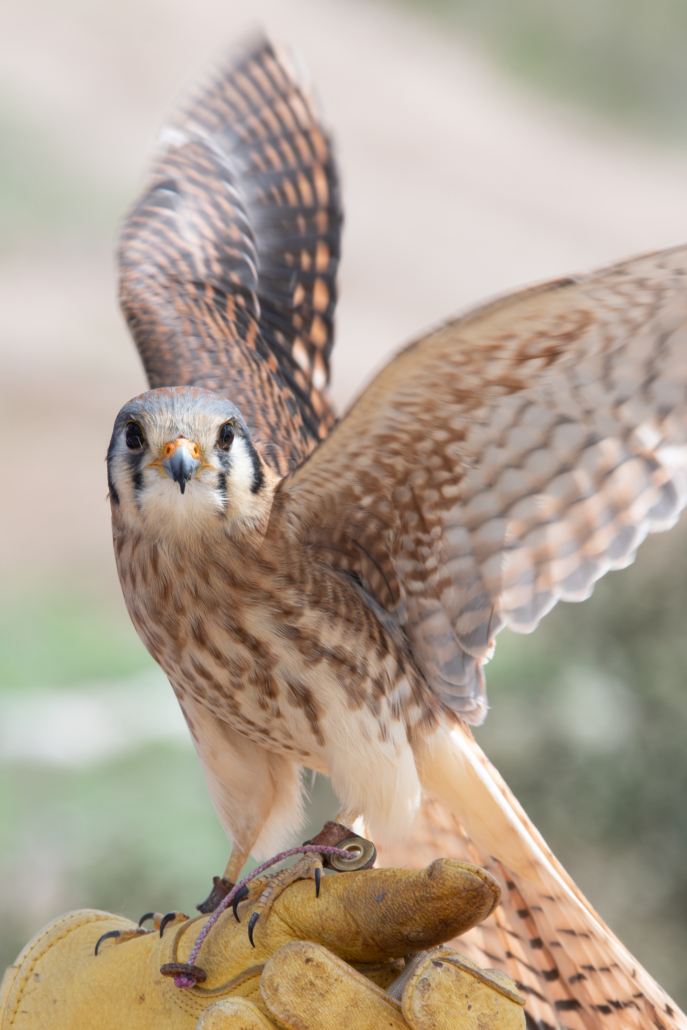
Amelia – American Kestrel
(Falco sparverius)
Amelia was brought to our wildlife hospital in June 2020 as a 30-day-old fledgling. It was immediately clear that Amelia had been raised by humans and not fed the appropriate diet. She was determined to be imprinted on humans and underdeveloped, which made her non-releasable. After a month in our wildlife hospital, we added her to our Ambassador Animal team and she jumped right in to education, debuting in her first virtual education program just one month after joining the team!
Photo of Amelia by Max Underwood
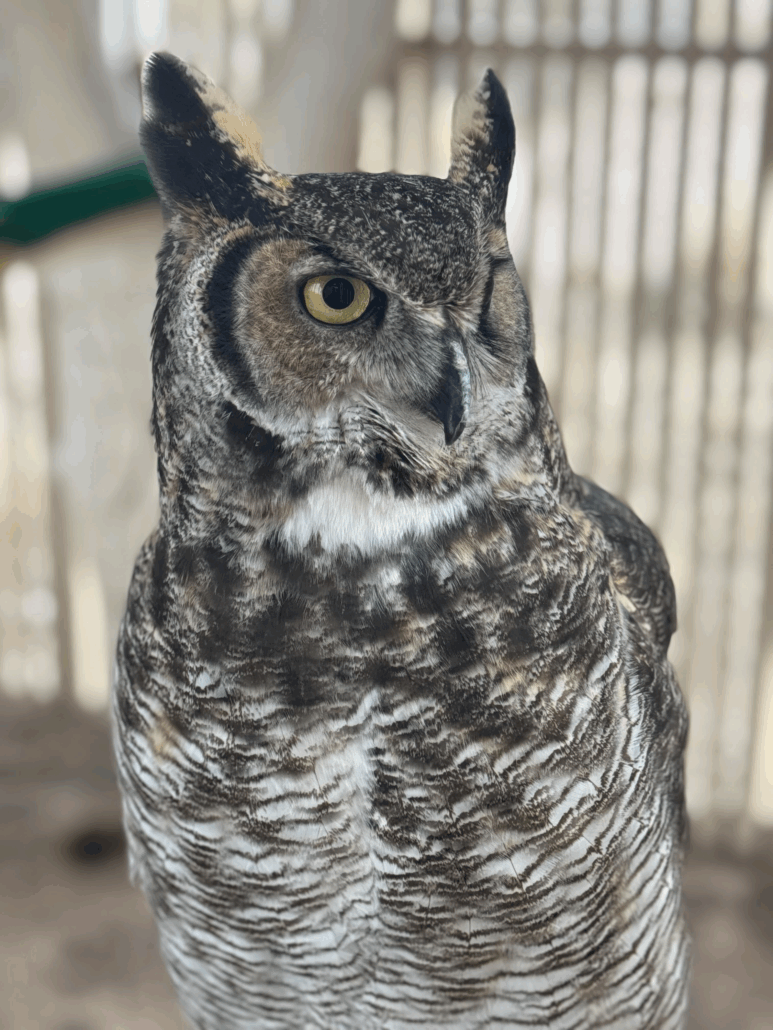
Bubo – Great Horned Owl
(Bubo virginianus)
Bubo was brought in to a wildlife hospital in Illinois as a nestling. Although raised by professional rehabilitators, Bubo never quite learned how to be a Great Horned Owl. When it came time to release her to the wild, she came back on her own to the only home she had known – one with people. The staff tried once more to return her to the wild, but when she returned a second time and begged for food, they realized she had become imprinted on humans and would never survive on her own. She was transferred to NMWC in 2017, at the age of two years old, to become an Ambassador Animal.
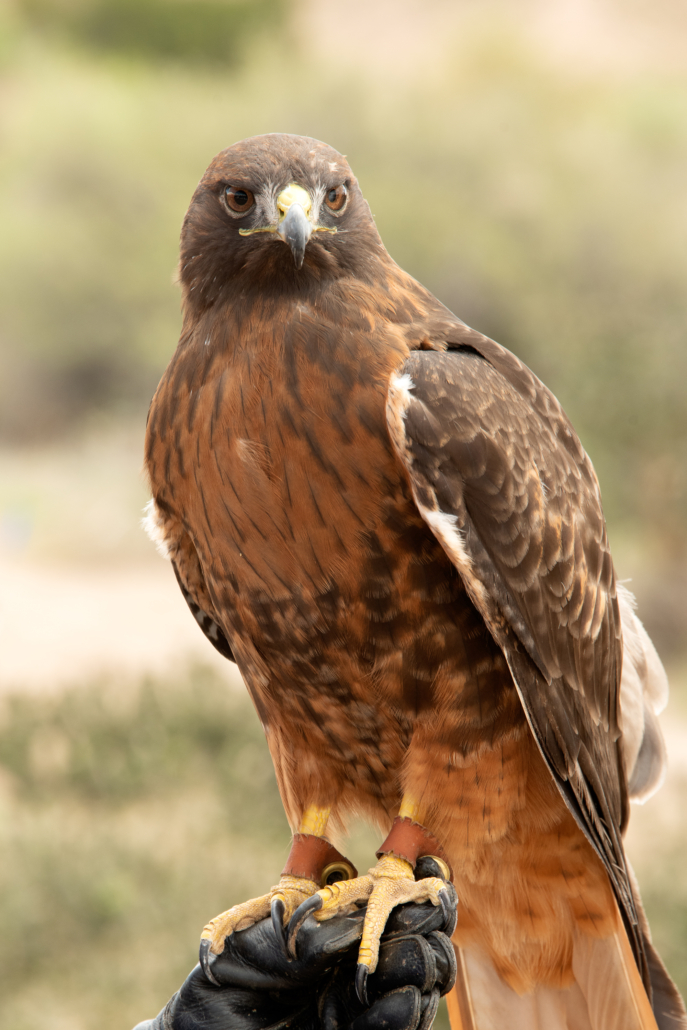
Cinder – Red-tailed Hawk
(Buteo jamaicensis)
Cinder was found sitting on the ground near the highway off the La Cienega exit along I-25 in the winter of 2018. With the help of the public and NMWC volunteers, she was brought to our Wildlife Hospital. She was emaciated and had injuries to her head and one eye. We think she might have been struck by a vehicle. After some time in our hospital it was determined that she had lost all vision in her left eye as a result of the incident. Unable to successfully hunt and survive in the wild, she became one of our Ambassador Animals.
Photo of Cinder by Max Underwood
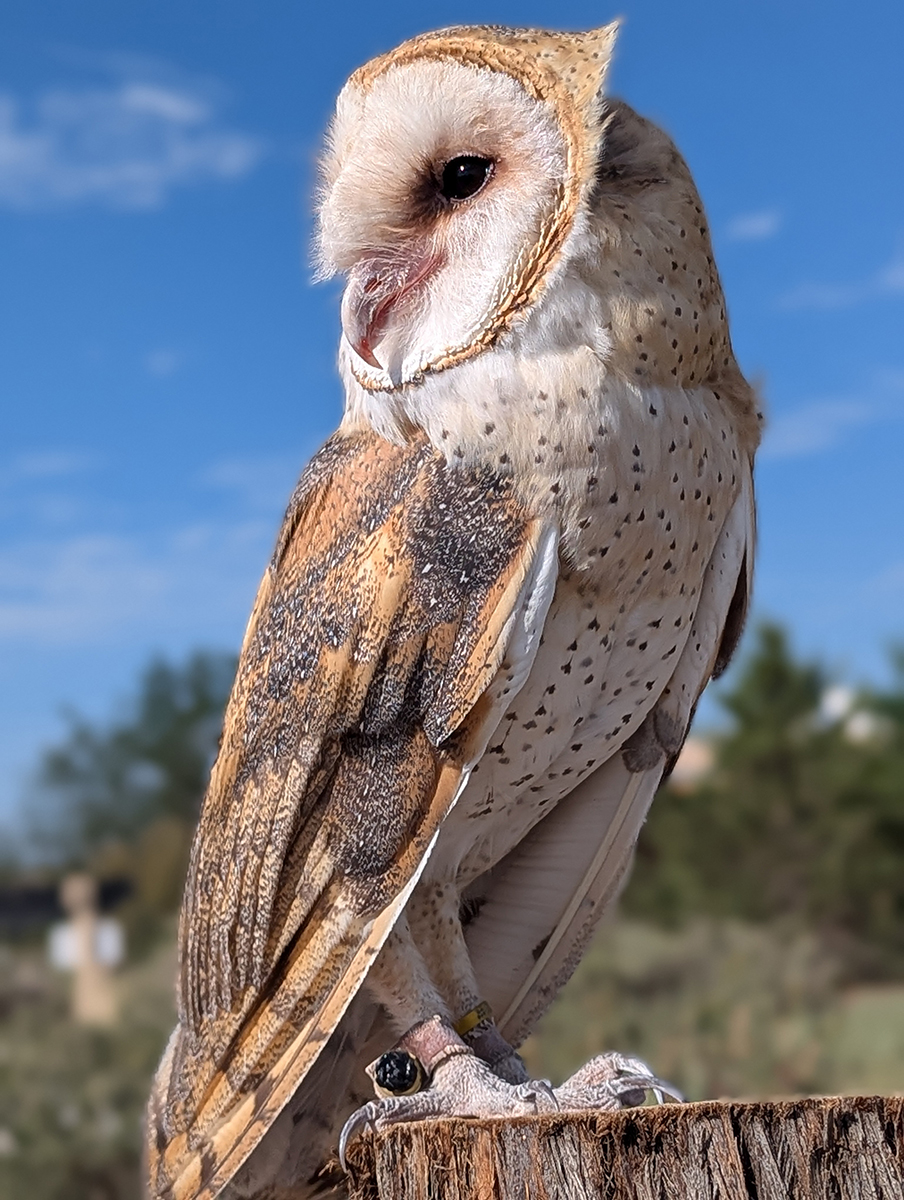
Corazón – American Barn Owl
(Tyto furcata)
Corazón was hatched on April 19, 2018, as part of a breeding project in the eastern United States. She was hand-raised by humans to be an educational ambassador for her species. Corazón, named for her heart-shaped face, came to live at NMWC to fulfill her role as an Ambassador Animal later that same year. Cora quickly became a hit, and her likeness has been captured by several New Mexico artists.
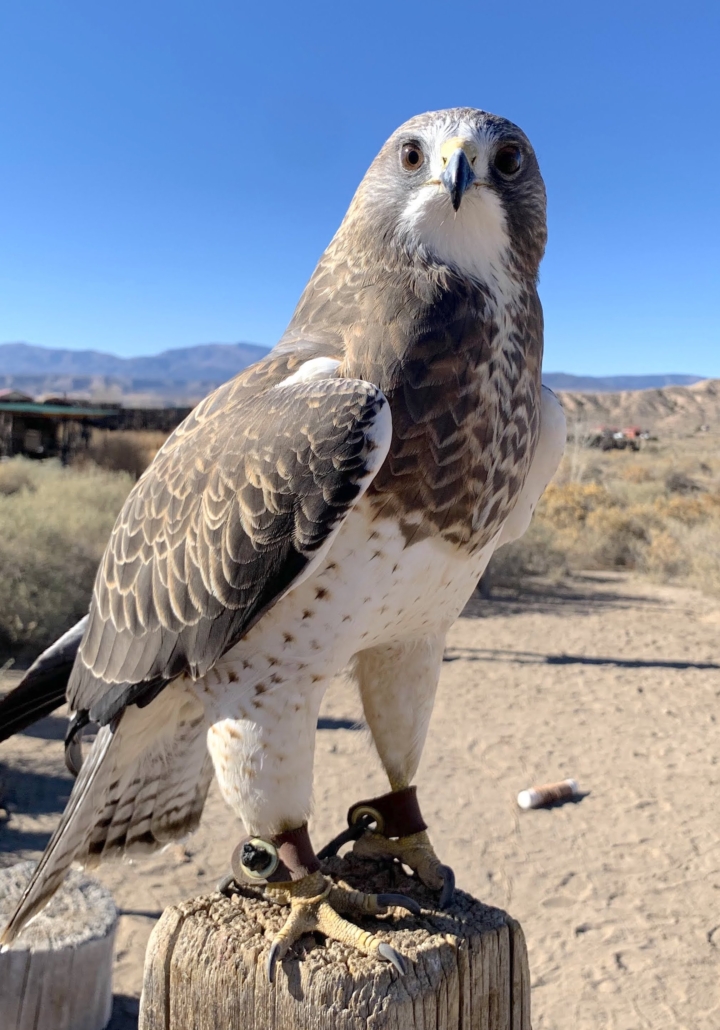
Cricket – Swainson’s Hawk
(Buteo swainsonii)
Cricket fell from her nest as nestling after a nearby tree removal operation in Albuquerque. Unable to return her to the nest, local wildlife rehabilitators attempted to raise her to return to the wild. Despite their best efforts, it was determined that Cricket was imprinted on humans. Cricket was transferred to New Mexico Wildlife Center in July 2018 to become an Ambassador Animal.
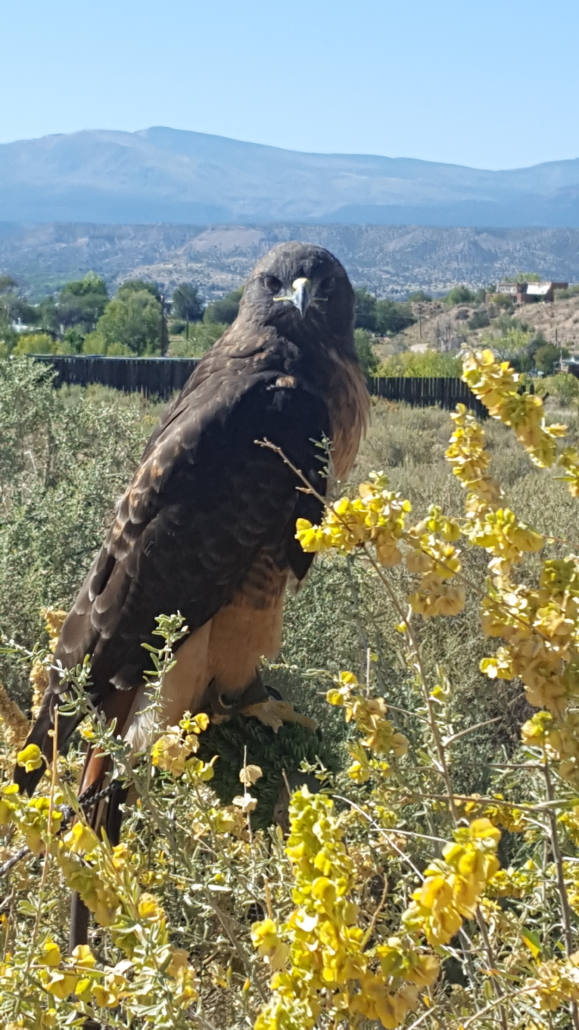
Dovahkiin – Red-tailed Hawk
(Buteo jamaicensis)
Dovah (short for Dovahkiin) is a retired falconry bird from California. After moving here with her falconer, Dovah suffered an injury while hunting which limited her ability to continue with the sport and thus could not be released. Since she spent her life helping educate people about falconry and raptor conservation, we knew NMWC would be the perfect place for her to continue her work! She has settled in wonderfully and debuted at our 2021 Open House.
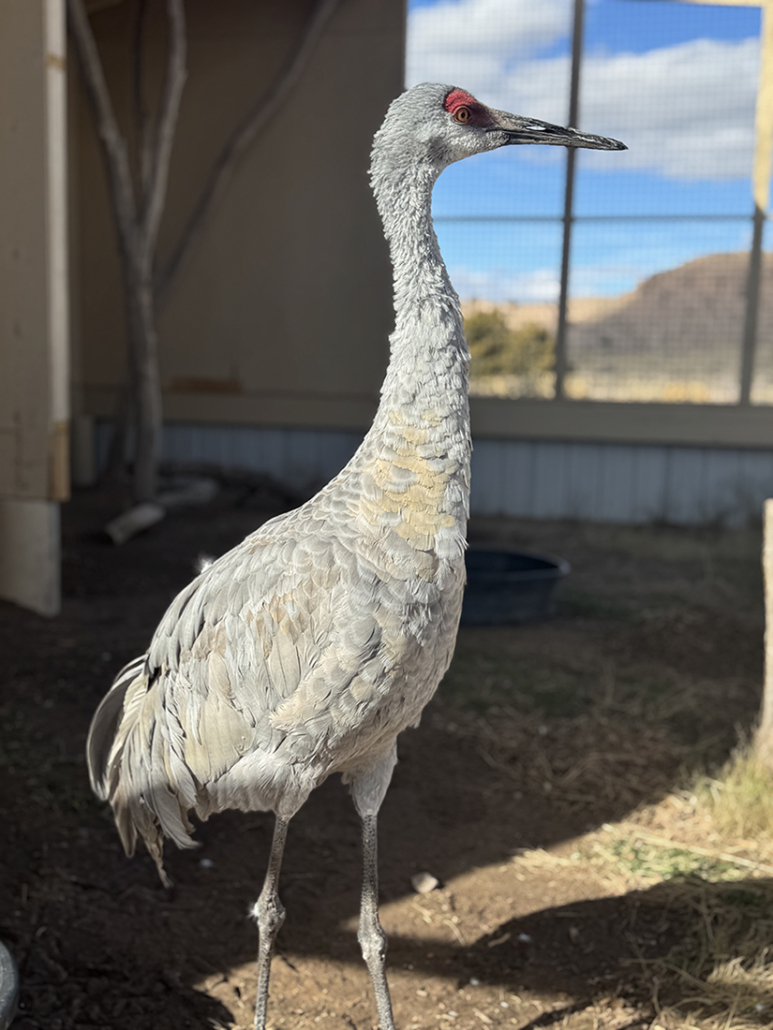
Echo – Sandhill Crane
(Antigone canadensis)
Echo was discovered walking up to people in a South Carolina parking lot, and was brought to a local rehabilitation center. After an assessment it was determined that he was far too used to humans to be released back into the wild, and the rehabilitators alerted non-releasable networks that he was up for placement. NMWC staff felt that he could be a great ambassador and help to demonstrate the biodiversity of our state and reached out to the South Carolina center. After the permit and approval process was complete, Echo traveled through eight states with one of our Education staff members to arrive at NMWC in July 2025!
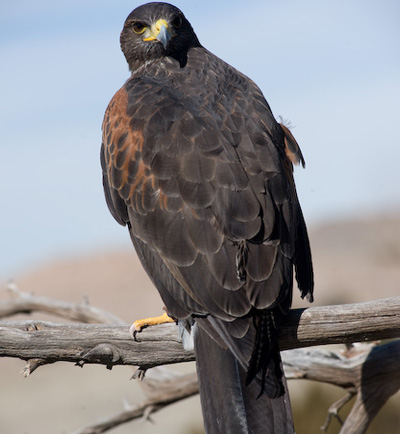
Lefty – Harris’s Hawk
(Parabuteo unicinctus)
Lefty was hatched in a breeding project in 2008 and has no physical impairments. He came to New Mexico Wildlife Center to be a NMWC Ambassador Animal in spring 2009. Lefty has one white talon on his left foot, which is how he got his name. Harris’s Hawks are unique among New Mexico’s raptors in that they are the only species known to regularly hunt cooperatively!
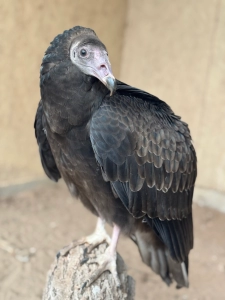
Mortimer – Turkey Vulture
(Cathartes aura)
Mortimer was one of two nestling vultures who fell out of their nest in Maryland in the summer of 2025. One was injured and passed away, while Mortimer survived and was cared for and fed by the finder for a while before being brought to a nearby rehabilitation center. Shortly after arrival, he was determined to be imprinted on humans, which made him non-releasable. NMWC had put the word out that we were looking for a Turkey Vulture to join our Ambassador Animal team, and the rehab center reached out to see if we were interested. Once the permit and approval process was completed, Mortimer traveled cross-country via car with a volunteer from the other organization and then with one of our education staff members, arriving at the end of September 2025.
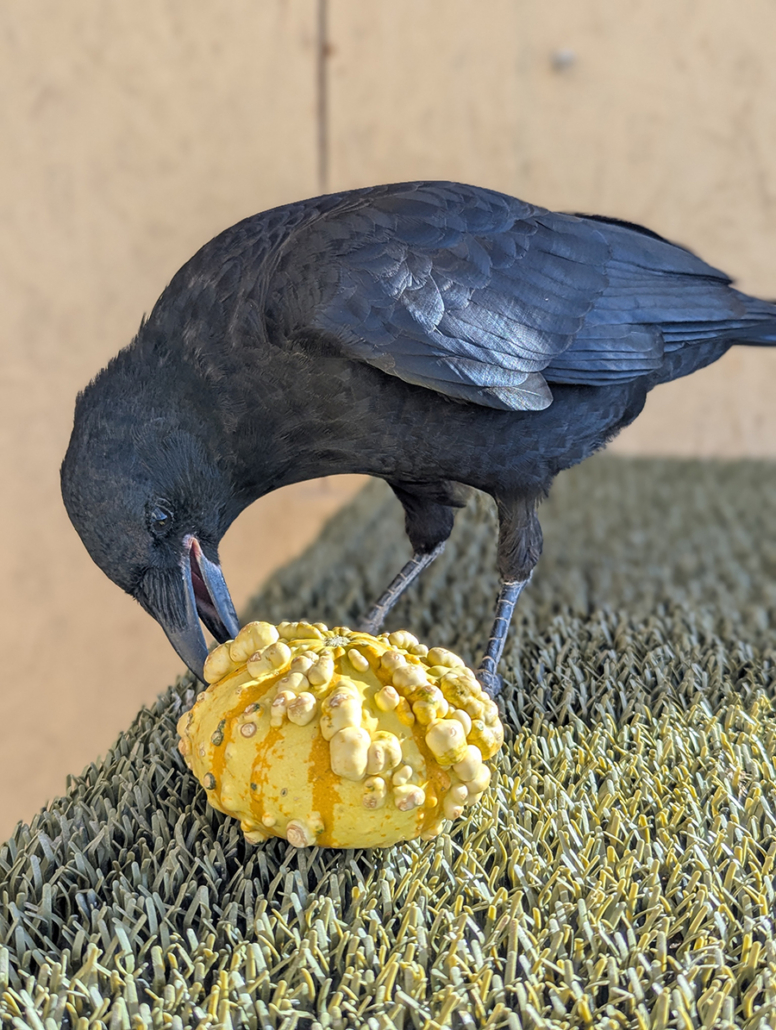
Onyx – American Crow
(Corvus brachyrhynchos)
Onyx was illegally abducted from the nest as a young bird in Wyoming by someone who decided they wanted a pet crow. A member of their community reported them and Onyx was confiscated and brought to a rehabilitation center, where he was determined to be imprinted on humans and considered non-releasable. The rehabilitation center reached out to NMWC directly about his potential as an Ambassador Animal, and our education staff felt he could be a great fit here. After the permit and approval process was complete and a really long day of driving, Onyx arrived at NMWC in July 2025.
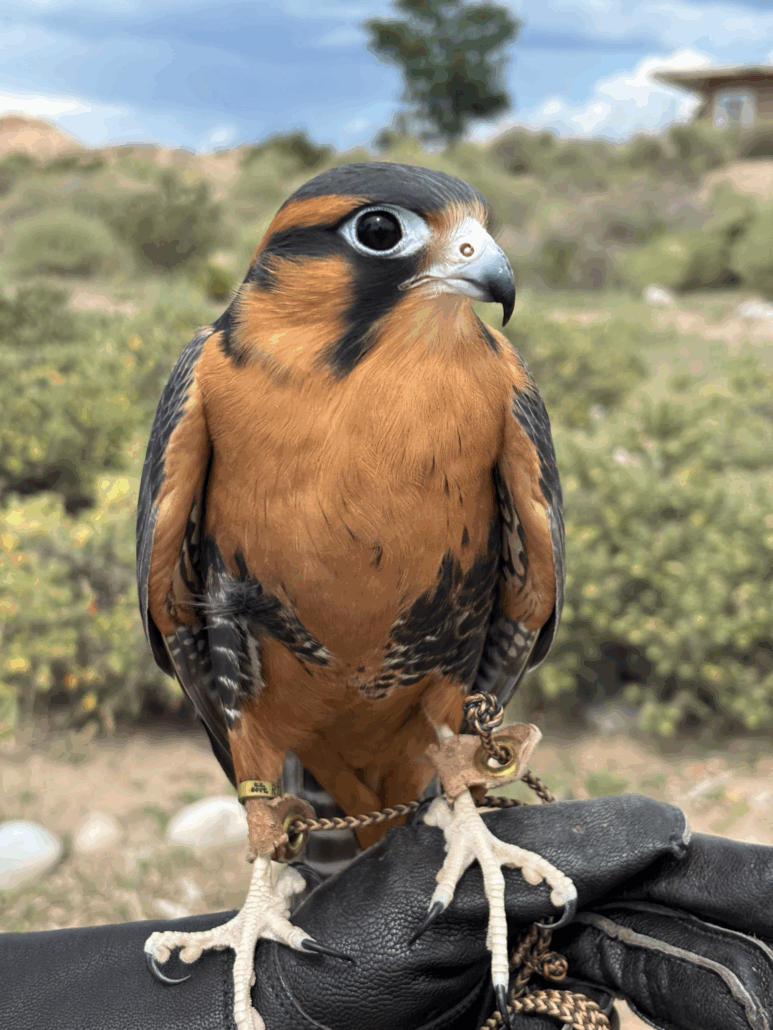
Phoenix – Aplomado Falcon
(Falco femoralis)
Phoenix hatched in human care in 2025 and was raised by NMWC staff to be an ambassador for his fascinating species. Aplomado Falcons once had established populations in New Mexico, but humans’ impact on the landscape has caused this species to become extirpated from the state. As of 2025, there are no longer any established Aplomado Falcon populations anywhere in New Mexico, and reintroduction efforts have been unsuccessful due to the lack of suitable habitat. Phoenix, in his role as an Ambassador Animal, helps us educate about human impacts on wildlife and the importance of preserving natural landscapes where wildlife can thrive.
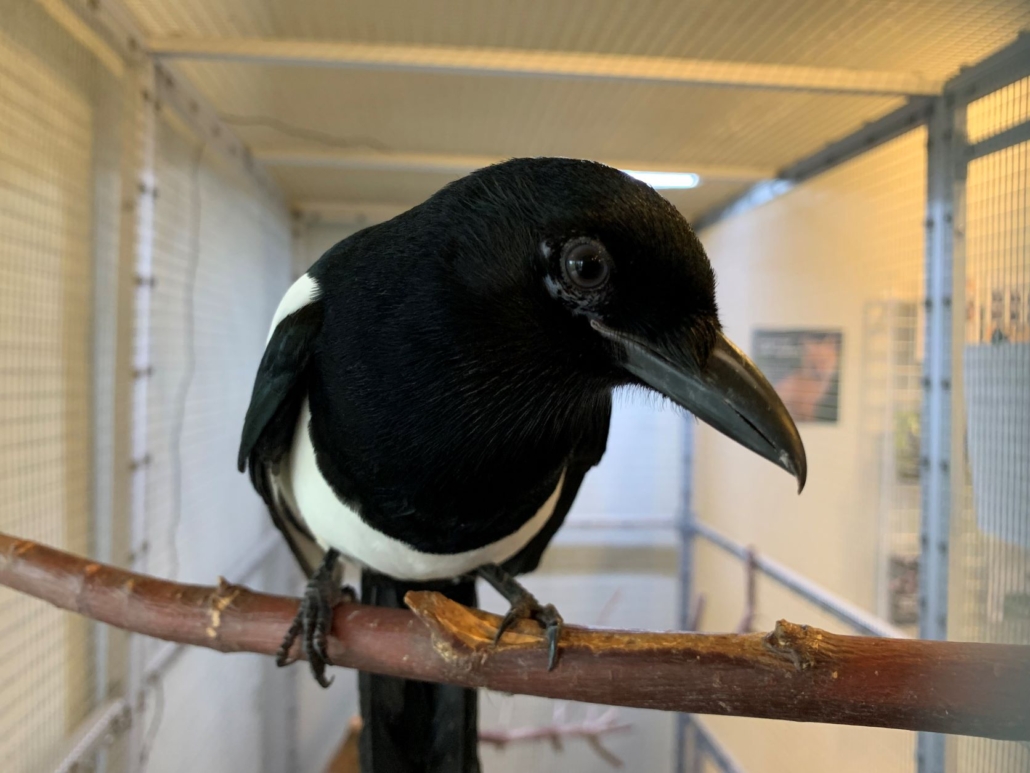
Pica – Black-billed Magpie
(Pica hudsonia)
Pica was brought to NMWC in 2021 after being kept illegally by humans for two years. Since Pica was raised by humans, she is a human imprint and does not know that she is a magpie. Pica immediately settled in to NMWC, vocalizing with a unique repertoire (often mimicking the sound of a soda can being opened) and copying new sounds from other Black-billed Magpie Cody.
Reptiles and Amphibians
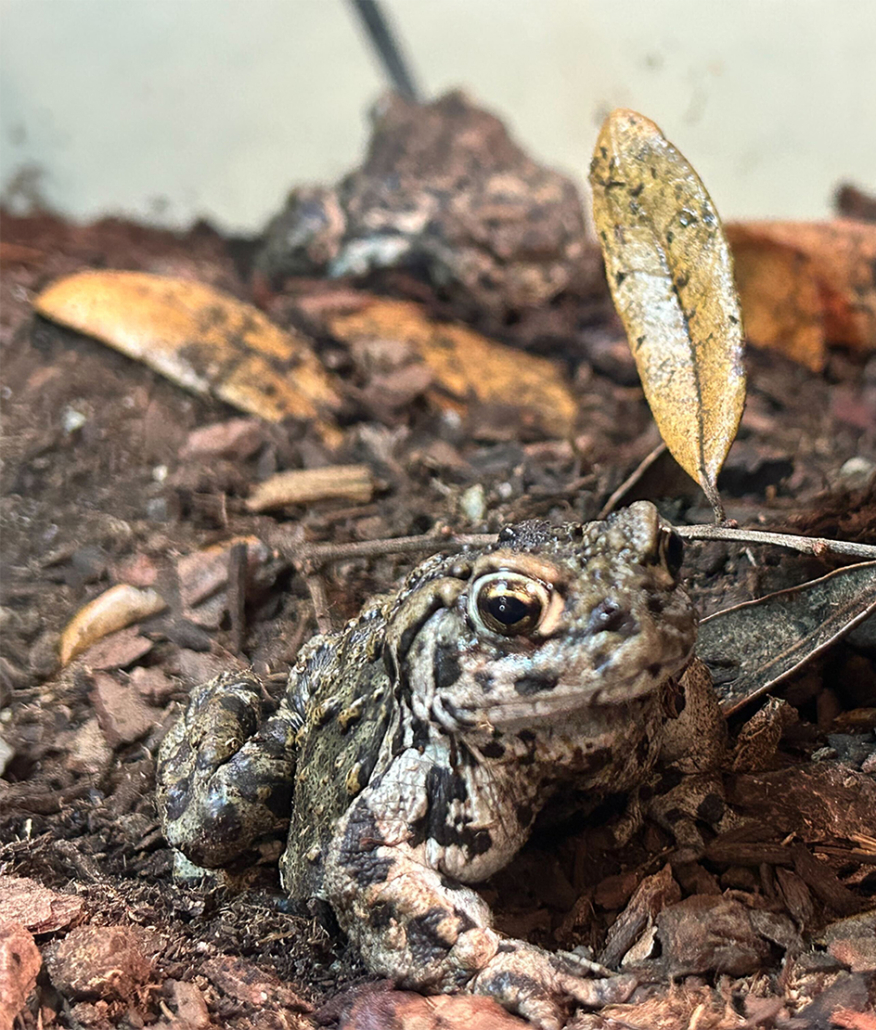
Boreal Toads
(Bufo boreas boreas)
The boreal toads at New Mexico Wildlife Center are part of a collaboration between NMWC and the Boreal Toad reintroduction program. Boreal toads were once common in high elevation habitats in the Southern Rocky Mountains, but are now considered extirpated from New Mexico. Extirpation is when a species has been completely eliminated from a specific region or area but still exists in other parts of their range. These female toads are retired from a conservation breeding program in Colorado after being well represented genetically in the program, and have reached the age where reproduction is no longer viable or safe for them. The common retirement age for female toads is between 6 and 12 years old. They are great ambassadors for their species and for teaching the public about extirpated species as a whole.
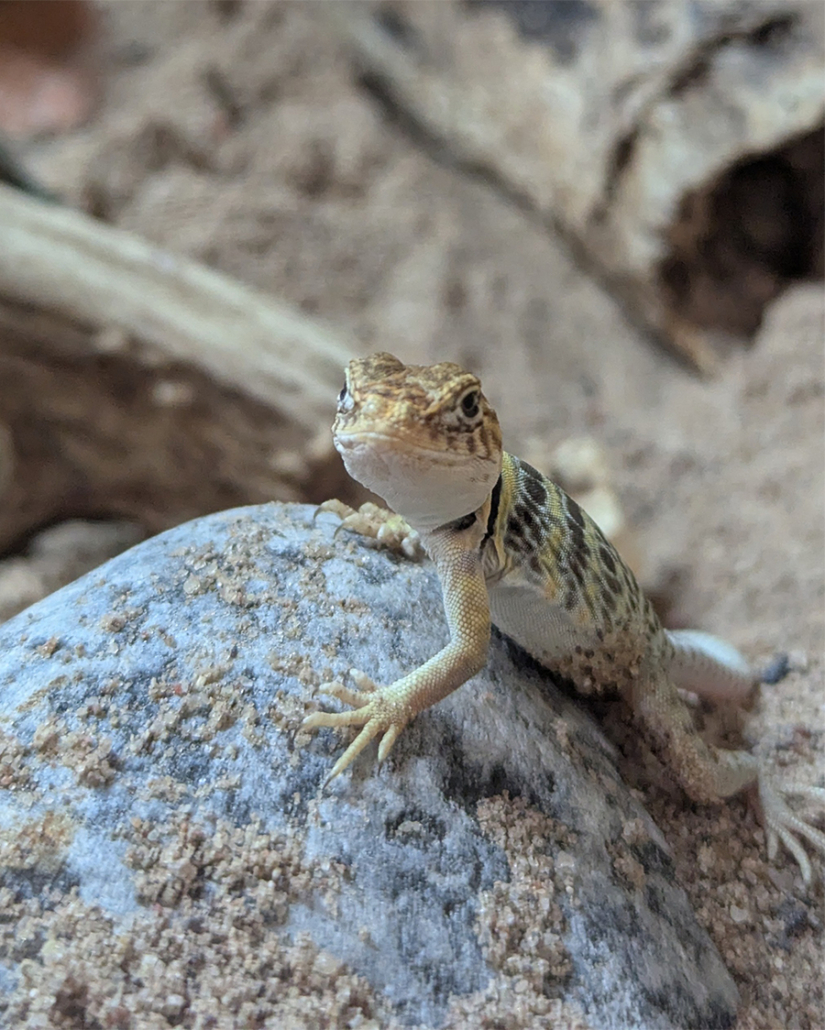
Canyon – Collared Lizard
(Crotaphytus collaris)
Canyon was hatched in human care by a licensed breeder in the second half of 2025, with genetics that originated in New Mexico. He arrived at NMWC in October 2025, weighing only 3 grams because he was still so small and young! Collared lizards can be identified by the two black “collars” around their necks and a white belly, with males more brightly colored than females. They are extremely fast to avoid potential predators in habitats like canyons, grasslands, and more.
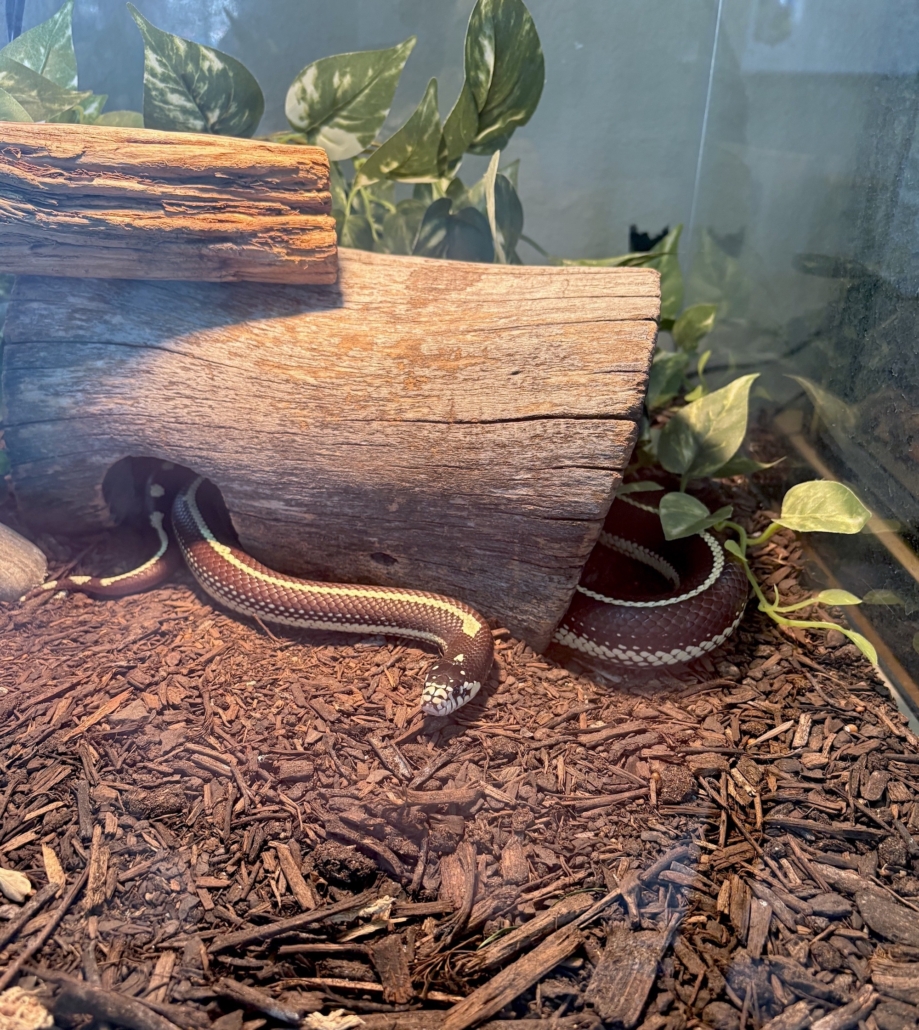
Diego – California Kingsnake
(Lampropeltis californiae)
Diego hatched in human care and was a breeder until he was 6 years old. He arrived at NMWC in 2025 after retiring from breeding. California kingsnakes can be found in the far northwest corner of New Mexico, although Diego’s color and pattern morph is found primarily in San Diego County, CA. The name “kingsnake” refers to this species’ dietary preferences in the wild: they often eat other snakes, including venomous snakes! Kingsnakes are not venomous themselves, but they are naturally resistant to rattlesnake venom.
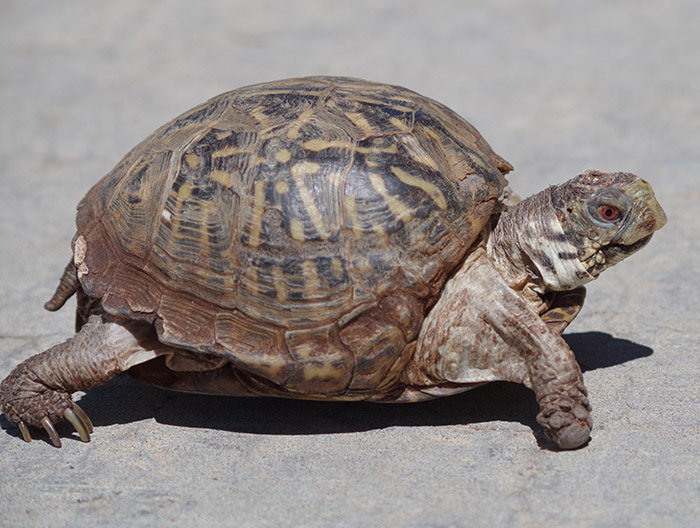
Frannie – Ornate Box Turtle
(Terrapene ornata ornata)
Frannie’s known life began as a kindergarten classroom pet in the 1990s. A student’s mother agreed to care for Frannie during one summer, resulting in the teacher asking the family to keep Frannie. For the next 28 years, this same family continued to care for Frannie and helped her survive a predator attack. With the children who once helped care for her grown and residing in another city, Frannie came to NMWC in 2018.
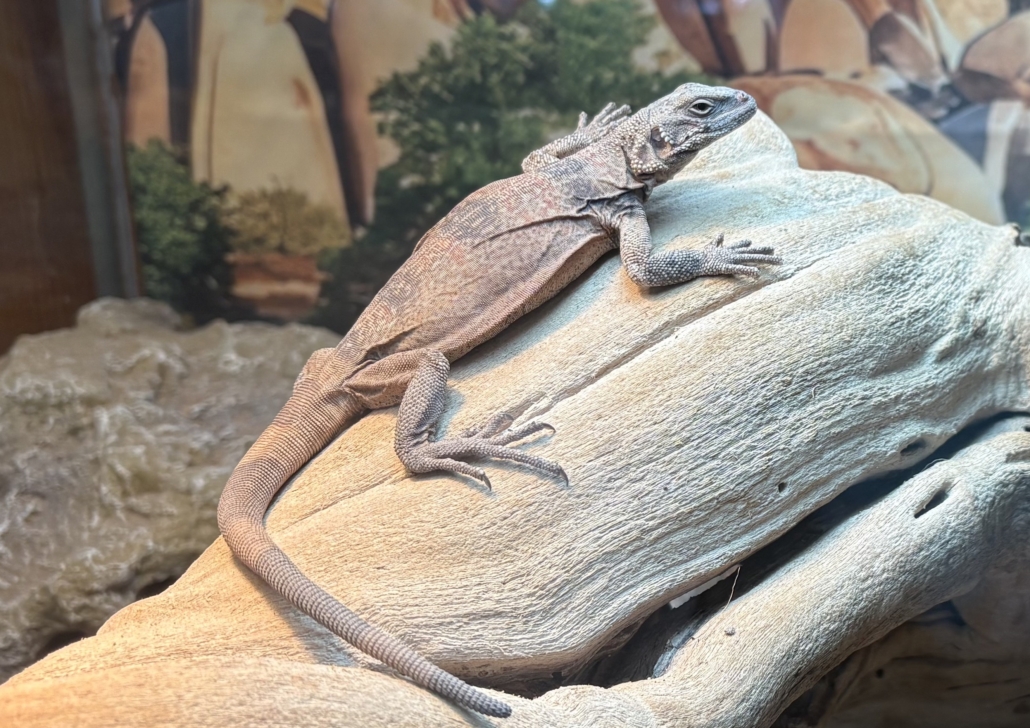
Mojave – Common Chuckwalla
(Sauromalus ater)
Mojave hatched in human care and came to NMWC in 2025 at almost 3 years old. His species can be found throughout parts of the American Southwest, specifically in dry habitats like the Mojave, Sonoran, and Chihuahuan Deserts. In the wild, chuckwallas avoid predators by wedging themselves into small rock crevices and inflating their body so they can’t easily be pulled out of their hiding spot! In order to accommodate that extra air, chuckwallas have loose skin on their abdomen that gives them a wrinkled appearance when not inflated.
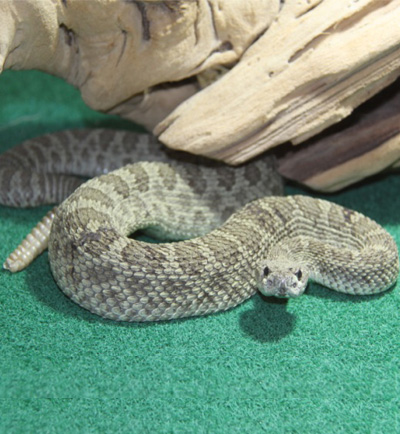
Napoleon – Prairie Rattlesnake
(Crotalus viridis)
In 2006, this snake was brought to New Mexico Wildlife Center from a visitor center in Pilar, NM, where he had become tangled in mesh netting. The netting caused permanent damage to Napoleon’s skin and scales that makes it difficult for him to shed properly. Because of this, he is not releasable. Napoleon is still fanged and has his venom, and he is on permanent display to help teach people how to identify these dangerous but beneficial snakes.
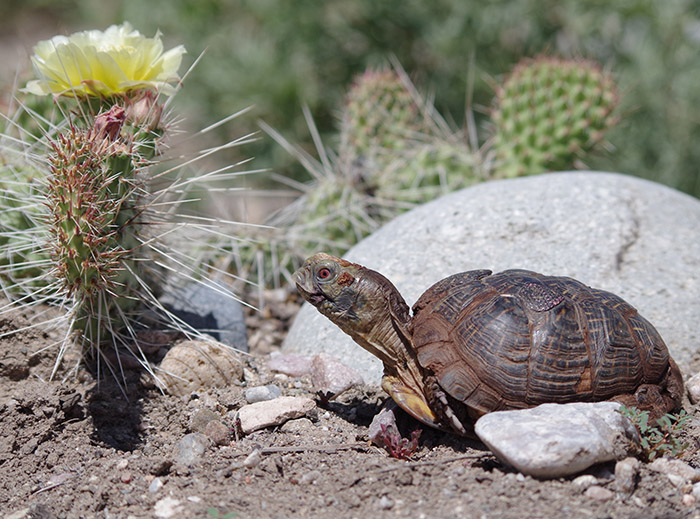
Patches – Desert Box Turtle
(Terrapene ornata luteola)
Patches was brought to New Mexico Wildlife Center in July 2017. He was found with multiple punctures to his carapace (top shell) and a fractured tail. The holes suggest he was attacked by a dog or other animal. After the initial intake, he was “patched” by a veterinarian with fiberglass patches and started on medications. The patches gave his shell punctures time to heal while reducing the risk of infection. Patches no longer has his fiberglass patches, but his shell never fully healed, which would leave him vulnerable to predators in the wild. He was unable to be released and became an Ambassador Animal in the fall of 2017.
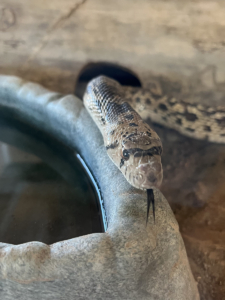
Pinyon – Bullsnake
(Pituophis catenifer sayi)
Pinyon was an education animal at another facility before coming to NMWC in 2022. Her coloring, pattern, and sometimes behavior are good indications of why Bullsnakes can be confused with rattlesnakes! However, Bullsnakes are non-venomous—and are excellent at rodent control.
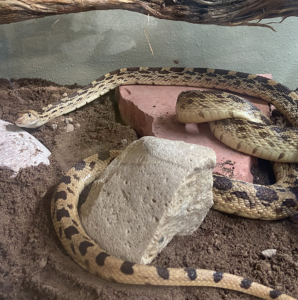
Sage – Bullsnake
(Pituophis catenifer sayi)
Sage spent time as an education animal at another facility before coming to NMWC in 2022. Because of her time in human care, she is very used to humans and being handled—in fact, she went to educational programs with us shortly after arriving! As one of the largest types of snakes in North America, she has quite an impact on crowds of children and adults alike.
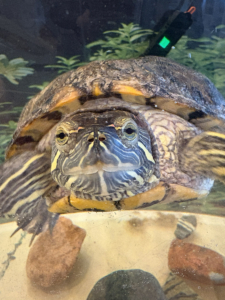
Sly – Red-Eared Slider
(Trachemys scripta elegans)
Sly was purchased at a pet store and later was no longer wanted. This is not an uncommon story for turtles, as they often grow much larger than expected and can live very long lives. Red-eared Sliders are only native to the far eastern edge of New Mexico; releasing a pet turtle to the wild can be dangerous to the life of the pet turtle, and also to other native species of turtles. Sly came to the New Mexico Wildlife Center in 2000 to be an Ambassador Animal.
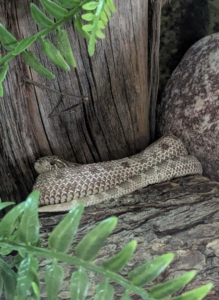
Truffle – Western Hognose Snake
(Heterodon nasicus)
Truffle hatched in human care in 2025 and was raised to be comfortable around people as an Ambassador Animal. The name “hognose” refers to this species’ distinctive upturned “snout,” similar to the flat nose of a pig. That face shape is created by a specially adapted rostral (nose) scale, and it makes these snakes excellent diggers. In the wild, they often prey on amphibians like frogs and toads, and they will also sometimes consume eggs and small mammals. Many of those prey items can be found by digging in soil, and hognose snakes like Truffle are perfectly equipped for that!
Mammals
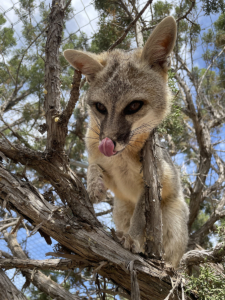
Juniper – Gray Fox
(Urocyon cinereoargenteus)
Juniper was taken from the wild by people as a kit. They kept and fed her for a quite a while (illegally) before turning her in to a local domestic animal shelter when she was 4 months old. Unfortunately, her time with humans made her completely dependent upon people and unable to be returned to the wild. Juniper became an Ambassador Animal in June 2019.
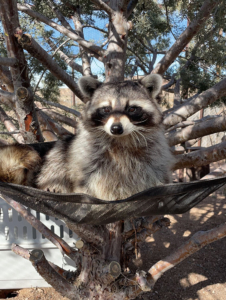
Pepper – Raccoon
(Procyon lotor)
Pepper was a young adult when he was confiscated by New Mexico state officials after being kept illegally as a pet. He was transferred to NMWC to be an Ambassador Animal in the summer of 2019.
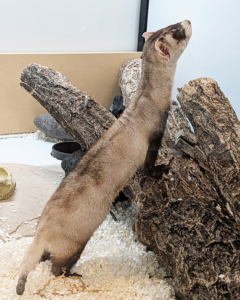
Phoenix – Black-footed Ferret
(Mustela nigripes)
Phoenix spent the first four years of her life in a conservation breeding program. Now retired, she came to NMWC from The National Black-footed Ferret Conservation Center in Colorado in 2026. She provides an opportunity to view one of North America’s rarest animals and is an example of efforts to save them from extinction. As one of New Mexico’s first Ambassador Black-footed Ferrets, she also represents the interconnection between BFFs, Prairie Dogs, and approximately 130 other animal species that call prairie grasslands home!
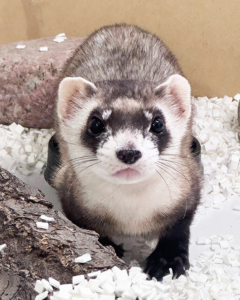
Virga – Black-footed Ferret
(Mustela nigripes)
Virga spent the first four years of her life in a conservation breeding program. Now retired, she came to NMWC from The National Black-footed Ferret Conservation Center in Colorado in 2026. As one of New Mexico’s first Ambassador Black-footed Ferrets, she provides an opportunity to view one of North America’s rarest animals. Virga, like all BFFs, is nocturnal (active at night). She spends much of the day in her burrow. If you are lucky you might see her pop out for a look around!
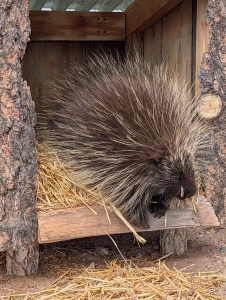
Yucca – North American Porcupine
(Erethizon dorsatum)
Yucca was born as part of a Species Survival Plan (SSP), which is a program where experts work together to maximize genetic diversity and distribution of a species among participating organizations. Yucca was hand-reared by professionals after being rejected by his mother, and so was destined to become an ambassador animal from early on. NMWC had put the word out that we were interested in a porcupine ambassador, and Yucca took a road trip with a staff member to NMWC to join the team, when he was still a young porcupette, before he was a year old!