Reflections of Our Founder
In the 1980s, there were no formal wildlife rehabilitation training programs. But at Colorado State University’s veterinary school, Kathleen Ramsay got a rough introduction that hooked her for life. “It all started in vet school over a Golden Eagle that was caught in a foothold trap. And the man hauled her in front of the clinic, and literally threw the trap at us, and said, ‘If you want to help her, here she is’,” Dr. Kathleen Ramsay recalls.
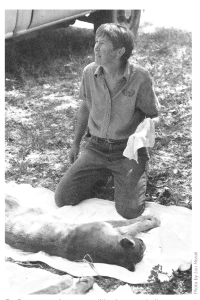
Dr. Ramsay tends to a tranquilized mountain lion in 2007.
Returning to her home state of New Mexico, Dr. Ramsay soon became known for treating more than dogs and cats. Her parents’ backyard in Los Alamos became a wildlife rehabilitation clinic, as did the parking lot at the vet clinic she established in Española. Anywhere she could fit a cage, she would. A bold pioneer during a time when, as Dr. Ramsay puts it, “nobody was stopping to help the snakes hit by a car on the road,” she founded what would become New Mexico Wildlife Center and named it Las Aves in 1986. About 15 years later, when the Rio Arriba fairgrounds planned to move, the need for more wildlife rehab space was met with a unique opportunity.
Dr. Ramsay remembers, “Richard Lucero, the mayor at the time here in Espanola, said, ‘Well, we’re gonna be moving the fairgrounds.’ So, we started a two-year discussion at that point with the Bureau of Land Management for acquiring this land, and it’s kind of an interesting thing. We may own it, but we can’t sell it for development. A friend of mine passed away, and the money she left me was enough to purchase the whole, entire 20 acres. And that’s when it moved out here.”
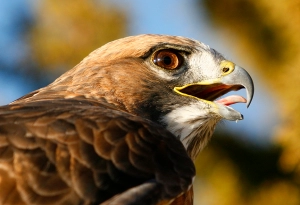
Inshallah the Red-tailed Hawk joined the Center as an educational ambassador in 1987 and was flown as a falconry bird but never learned how to kill.
Ambassadors and Awe
Success in any endeavor depends on supporters, community, and partners. Dr. Ramsay found out quickly that “funding is massively huge and very complex.” Key to engaging others was an ambassador who could represent efforts to help injured wildlife. That was Oscar, or Oscarette, as Dr. Ramsay affectionately calls the Great Horned Owl that served as the Center’s first educational animal. Thirty-eight years later, Oscar passed away after many years of serving as foster mom to other owls that were returned to the wild. (Read more of Oscar’s story here.)
Another animal partnership that influenced Dr. Ramsay’s path was a Red-tailed Hawk that she trained as a falconer. Dr. Ramsay explains, “I used to turn her loose at the clinic and fly her all around those fields all the time. Yeah, she was a lot of fun. Her name was Inshallah, which is Arabic for, ‘If God wills it, I might, and if God doesn’t will it, I probably won’t.’ That was her philosophy as a falconry bird, and she was here for 20 plus years.”
Over those decades, Dr. Ramsay watched the impact Oscar, Inshallah, other ambassador animals, and broader wildlife education made on her community. “The whole outlook of people in New Mexico, and actually all over the world, about rehab has changed and progressed from the ’80s. Again, we wouldn’t have called for help on a coyote. We would have gotten a gun out and shot the coyote. So, over the years, teaching people that these animals have a value. . . Yes, it is only one animal. But if that one hawk can be a permanent spot in a child’s brain and teach that child – Wow! That’s really neat. And what is that value? That hawk has accomplished more than anything you can do in the wild. And so that’s how it started.”
Forty years later, more than 11,000 visitors per year engage with New Mexico Wildlife Center’s educational ambassadors through self-guided or guided tours, field trips, and special events.
Progress of Wildlife Care
Although the education programs make a big impact and are what many people picture when they think of the Center, it started as a hospital and rehabilitation facility. But New Mexico is too big to have only one, and a network is needed. Dr. Ramsay says, “The more outreach we do, and the more we get back into the community, the more you become aware of who the wildlife Center is.”
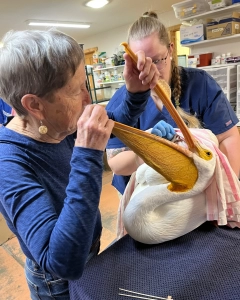
Dr. Ramsay and Wildlife Rehabilitator Lizz Kendall examine an American White Pelican admitted in 2025 that was significantly dehydrated.
In 2012, Dr. Ramsay turned her attention to her veterinary practice outside of the Center’s, while still providing specialized support when the Center calls on her. She has attracted attention for her willingness to rehabilitate everything from pigeons to elk and continues to fill a great need for taking care of injured bears at her facility. She has treated 680 bears, so far. She says, “Every animal you work on is more training. It doesn’t matter, if you quit learning, you’re done. No two are the same.”
Year by year, environmental variables cause hardships for wildlife. Dr. Ramsay says, “Rain, no rain, drought, no drought. Did we have late freezes? Do we have winter forbes out there?” In 2000, a momentous tragedy brought sudden lessons with the Cerro Grande fire that swept through the forest surrounding Los Alamos and nearby communities. Fifty-six bears were displaced. Most were hit by cars and had elbow fractures. Yearling cubs that came in the following winter were starving to death. They’d gotten separated from their mothers and didn’t gain enough weight to hibernate. Dr. Ramsay explains, “We got them in at 6 pounds in January when they should have been 65 to 85 pounds.”
One of her achievements and a lesson she is still trying to teach other rehabilitators is how to feed malnourished wildlife carefully and slowly. Dr. Ramsay says, “You don’t just go feed it. You bring it up really slow, and you do caloric work. Twenty years ago, that didn’t exist. We didn’t have any of that ability.”
Rehabilitation Networks
Has the increase in awareness and actions that rescuers take kept up with the changing times? Dr. Ramsay provides a reality check. “There are more and more rehab centers than when I started the wildlife center. There wasn’t even one in Colorado. So, as we start to see these develop and grow, there’s a tremendous amount now of networking, which didn’t exist when I was starting out, and again, that’s part of our growth.” However, human activities haven’t changed, and our population increase and encroachment on wildlife habitat is outpacing the remedies that wildlife centers can provide. Dr. Ramsay says, “Bird strikes, that’s not gonna change. You can make people aware of it, but it’s not going to change because we’re increasing the number of housing units.” Similarly, she questions, “It’s not going to change cats. How are we ever going to convince people to keep their cat indoors?”
What is the solution to this ever-expanding problem? Even the veterinarian who has seen it all and has every reason to become cynical still believes in the power of prevention. Dr. Ramsay recounts situations where people with good intentions are creating unfixable problems by feeding bear cubs or habituating cougars. To prevent the death of raccoons in a chimney, for example, she says, “How can we preempt the problem before next year? How can you get chimney caps on?” Proactive community education is the gap that wildlife rehabilitation centers throughout New Mexico are filling.
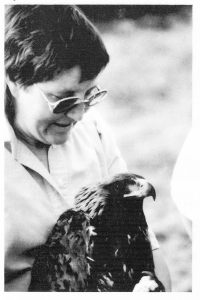
A Golden Eagle in Dr. Ramsay’s arms, one of several eagle patients admitted in 1991, received skilled care and was released back to the wild.
A Lasting Legacy
There’s no doubt that Dr. Ramsay gives her all to animals, but it may come as a surprise that wildlife rehabilitation was not her first career. She had been a metallurgist until life circumstances led her to make a drastic pivot to begin vet school. Like letting go of that path, letting go of patients is part of the deal. Does she ever consider the path not taken? “No, I have no regrets of anything I’ve done. Even in the vet world, I have no regrets. I love every minute of it,” Dr. Ramsay states. “I’m just about 70, and I’m still head over heels in love. I’m working on a bear cub right now that’s gonna be touch-and-go to whether we can get her back into the wild, but there is nothing I won’t try. Every animal deserves that second chance.”
Reflecting on her lifetime of service after getting hooked by that one raptor in vet school, Dr. Ramsay expresses what legacies she may leave. “The New Mexico Wildlife Center is one of them. It is making a difference. I can go to bed, and I can die knowing I made a little difference, knowing I tried. I’ll lose a lot. But I try.”